


Select A Store
Select Store
My Store:
Select A Store
Overview
Overview
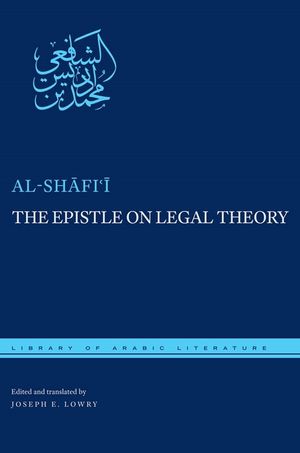
The Epistle on Legal Theory is the oldest surviving Arabic work on Islamic legal theory and the
foundational document of Islamic jurisprudence. Its author, Muhammad ibn Idris al-Shafi'i (d.
204 H/820 AD), was the eponym of the Shafi'i school of legal thought, one of the four rites in
Sunni Islam. This fascinating work offers the first systematic treatment in Arabic of key issues
in Islamic legal thought. These include a survey of the importance of Arabic as the language of
revelation, principles of textual interpretation to be applied to the Qur'an and prophetic Traditions,
techniques for harmonizing apparently contradictory precedents, legal epistemology, rules
of inference, and discussions of when legal interpretation is required. The author illustrates his
theoretical claims with numerous examples drawn from nearly all areas of Islamic law, including
ritual law, commercial law, tort law, and criminal law. The text thus provides an important window into both Islamic law and legal thought in particular and early Islamic intellectual history in general.
The Arabic text has been established on the basis of the two most important critical editions and includes
variants in the notes, while the English text is a new translation by a leading scholar of Shafi'i and his thought. The Epistle on
Legal Theory represents one of the earliest complete works on Islamic law, one that is centrally important for the formation of
Islamic legal thought and the Islamic legal tradition.
- Format: Hardcover
- Author: Al-Shafi'i, Muhammad Ibn Idris
- ISBN: 9780814769980
- Condition: New
- Dimensions: 9.10 x 1.60
- Number Of Pages: 544
- Publication Year: 2013
Language:
English