


Select A Store
Select Store
My Store:
Select A Store
Overview
Overview
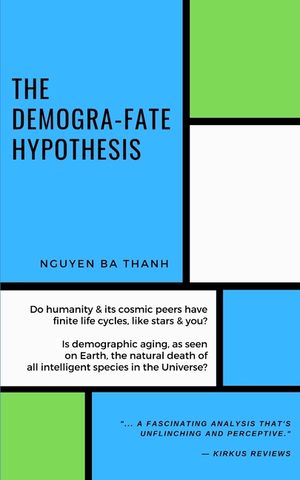
The demogra-fate hypothesis was first published in a "Philosophy Now" Oct/Nov 2016 article. Nguyen Ba Thanh runs the blog Demographic Fate which chronicles and tries to make sense of worldwide population aging and decline. A full-time trend analyst, he lives in Hanoi, Vietnam.
If everything-bodies, memories, stars, the universe itself-has a birth-death life cycle, can humankind exist forever? As they modernize, birthrates in 100+ countries have fallen below the replacement minimum of 2.1 births/woman. Sustained sub-2.1 fertility will make societies older and smaller. With India, South Africa, Mexico... crossing below the 2.1 threshold, will the entire species follow fast-aging and shrinking Japan, whose rising median age may top 60 well before 2100?
Enter our demogra-fate hypothesis: does population aging conclude the natural life cycle of all intelligent species in the universe?
With no say in their own birth, high-tech species are just randomly evolved wildflowers of the great cosmic desert. While sentient life may have arisen separately in lonely oases far across the cosmos, are aliens and humans that different in nature or destiny? Due to the unfathomable vastness of space, there should be quite a few of us. Even if only one civilization exists for every ten galaxies, there will still be around 20 billion civilizations concurrently alive within our observable universe of (200 billion galaxies) times (200 billion stars per galaxy). Can 0.3-million-year-old humankind survive until the death of this Big Bang-started universe in tens of billions of years in a Big Crunch/Chill/Rip scenario? Or do intelligent species-brainier but always part of wild nature-just blindly and purposelessly bloom and die, here one million years and gone the next? With no say in their own death, like true desert wildflowers?
How, actually, do high-tech societies grow old and die naturally? Isn't population aging & decline on Earth the observable end of an inescapable life cycle? Does this natural demographic fate await all cosmic civilizations that survive youthful troubles? Without individual immortality, all alien species should have a rising median age when reproduction stays below replacement. Though galaxies apart, are those enlightened societies all helpless against nature's birth-death law? Despite being conscious of such law, something no lower species is capable of? Much like humans being aware of yet helpless against their own bodies' aging and dying?
In deciphering intelligent life's (wild?) nature and (fleeting?) destiny in the universe, the demogra-fate hypothesis is empirically based. Population aging & decline has been widely spotted and measured in the very first alien civilization ever studied: our own. Until refuted by other cases of sentient life, shouldn't this most factually verifiable hypothesis be prioritized?
An intelligent species fades here, another pops up in a nearby galaxy... yet another dull day in infinity. There's no good, bad, or purpose to it; it's all wild nature.
- Format: Trade Paperback
- Author: Nguyen-Ba, Thanh
- ISBN: 9798531458612
- Condition: New
- Dimensions: 8.00 x 0.26
- Number Of Pages: 124
- Publication Year: 2021
Language:
English