


Select A Store
Select Store
My Store:
Select A Store
Availability:
-
Online Only
$18.49
Overview
Overview
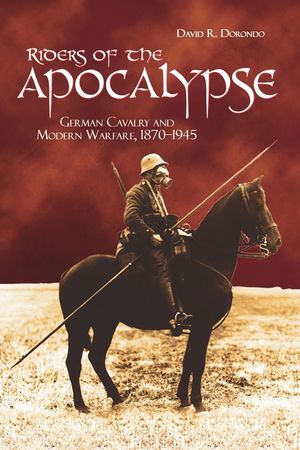
Despite the enduring popular image of the blitzkrieg of World War II, the German Army always depended on horses. It could not have waged war without them. While the Army's reliance on draft horses to pull artillery, supply wagons, and field kitchens is now generally acknowledged, D. R. Dorondo's Riders of the Apocalypse examines the history of the German cavalry, a combat arm that not only survived World War I but also rode to war again in 1939. Though concentrating on the period between 1939 and 1945, the book places that history firmly within the larger context of the mounted arm's development from the Franco-Prussian War of 1870 to the Third Reich's surrender.
Driven by both internal and external constraints to retain mounted forces after 1918, the German Army effectively did nothing to reduce, much less eliminate, the preponderance of non-mechanized formations during its breakneck expansion under the Nazis after 1933. Instead, politicized command decisions, technical insufficiency, industrial bottlenecks, and, finally, wartime attrition meant that Army leaders were compelled to rely on a steadily growing number of combat horsemen throughout World War II. These horsemen were best represented by the 1st Cavalry Brigade (later Division) which saw combat in Poland, the Netherlands, France, Russia, and Hungary. Their service, however, came to be cruelly dishonored by the horsemen of the 8th Waffen-SS Cavalry Division, a unit whose troopers spent more time killing civilians than fighting enemy soldiers.
Throughout the story of these formations, and drawing extensively on both primary and secondary sources, Dorondo shows how the cavalry's tradition carried on in a German and European world undergoing rapid military industrialization after the mid-nineteenth century. And though Riders of the Apocalypse focuses on the German element of this tradition, it also notes other countries' continuing (and, in the case of Russia, much more extensive) use of combat horsemen after 1900. However, precisely because the Nazi regime devoted so much effort to portray Germany's armed forces as fully modern and mechanized, the combat effectiveness of so many German horsemen on the battlefields of Europe until 1945 remains a story that deserves to be more widely known. Dorondo's work does much to tell that story.
- Format: Hardcover
- Author: Dorondo, David R.
- ISBN: 9781612510866
- Condition: Used
- Dimensions: 9.10 x 1.20
- Number Of Pages: 336
- Publication Year: 2012
Language:
English