


Select A Store
Select Store
My Store:
Select A Store
Availability:
-
Online Only
$14.62
Overview
Overview
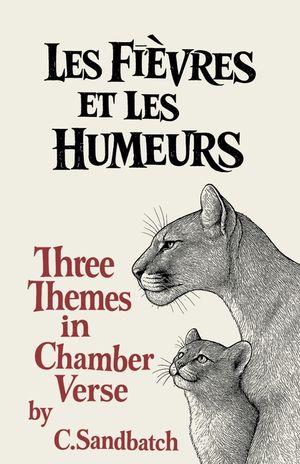
In Les Fièvres et les Humeurs, lyric poetry is permitted to concern itself with order, gravity, and the spiral of a single emotion's mutation under moral constraint and consequence. This is poetry without consolation, and without confession.
The book is arranged in three movements-Obsession, Ruin, and Désir-not as psychological themes but as governing conditions. Each establishes a tonal field in which recurrence, collapse, and residue are tested for endurance. The organizing principle is musical rather than narrative: poems are scored in keys rather than arranged by subject, allowing dissonance while refusing arbitrariness.
In the first movement, obsession appears as formal recurrence: fixation, variation, and excess of return. Images and gestures are repeated until they either break or prove capable of bearing weight. In the second, ruin is treated not as aftermath but as an atmosphere of crisis; a civic and ethical condition in which structures decay at unequal speeds. The final movement turns toward desire, not as appetite, but as what remains after obsession exhausts itself and ruin forges its restraint.
Throughout, the poems move between strict forms and freer measures-sonnets, variations, cantatas, monodies-without nostalgia for harmony and without indulgence in disorder. Form here is not decoration but discipline: a means of testing whether intensity can justify itself as meaning.
This volume is the author's debut full-length collection, published by St. Expedite Press, an independent imprint based in New Orleans, where the book's sensibility-its attention to ritual, decay, endurance, and lived climate-finds a natural correspondence. The book presents itself as a unified object rather than a curated assortment.
Poems, neither of immediacy, nor of personal revelation; they emerged from a very old place, and from that place they inherited very old themes.
Rather than attempt vainly to solve those themes, a song is made from them.- Format: Trade Paperback
- Author: Sandbatch, Christopher
- ISBN: 9798994203507
- Condition: New
- Dimensions: 8.50 x 0.17
- Number Of Pages: 72
- Publication Year: 2026
Language:
English